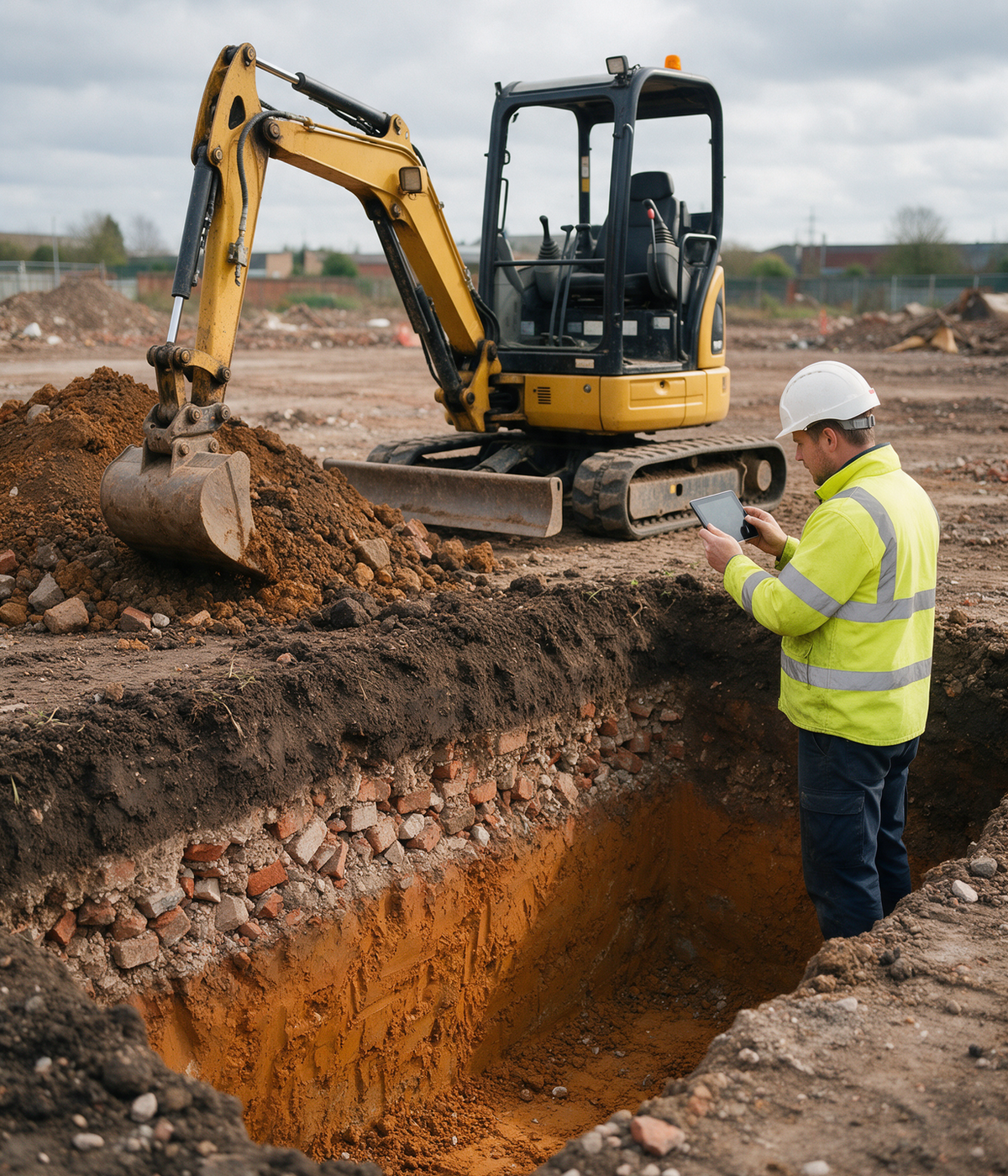
01Dig, look, log.
Trial pits are dug with a mini excavator or backhoe, or by hand, usually to between about 1m and 4.5m. Each pit is logged layer by layer, photographed and sampled, and any groundwater is recorded. When we finish, the pit is backfilled with the dug material in reverse order and compacted.
Pits are positioned so they will not affect your future foundations.
Safety first: we never enter unsupported excavations. Logging and sampling are done from the surface or from the excavator bucket.
02A clear look at your ground.
- A log of the strata, with photographs.
- Large bulk samples for laboratory testing, which boreholes cannot provide.
- Groundwater observations.
- Environmental samples where contamination is suspected.
03Trial pits or boreholes?
Trial pits are quick and good value, and show the ground in detail to a few metres. Boreholes are needed for anything deeper, or where a pit is not practical, for example in a tight garden or beside an existing building. Many sites use both. Our guide on trial pits or boreholes explains how to choose.
A trial pit can also form the test pit for a soakaway test.
04Questions we get asked.
Trial pits or boreholes?
Trial pits are quick and good value, and show the ground in detail to a few metres. Boreholes are needed for anything deeper or where a pit is not practical.
Will my garden be left in a mess?
Pits are backfilled with the dug material and compacted when we finish. Talk to us about access and reinstatement when you ask for a quote.
Does someone go down into the pit?
Not into an unsupported excavation. We log and sample from the surface or the excavator bucket.
How much does a trial pit cost?
It depends on the number of pits, depth, access and any testing. Send us the site details and we will give you a clear quote.