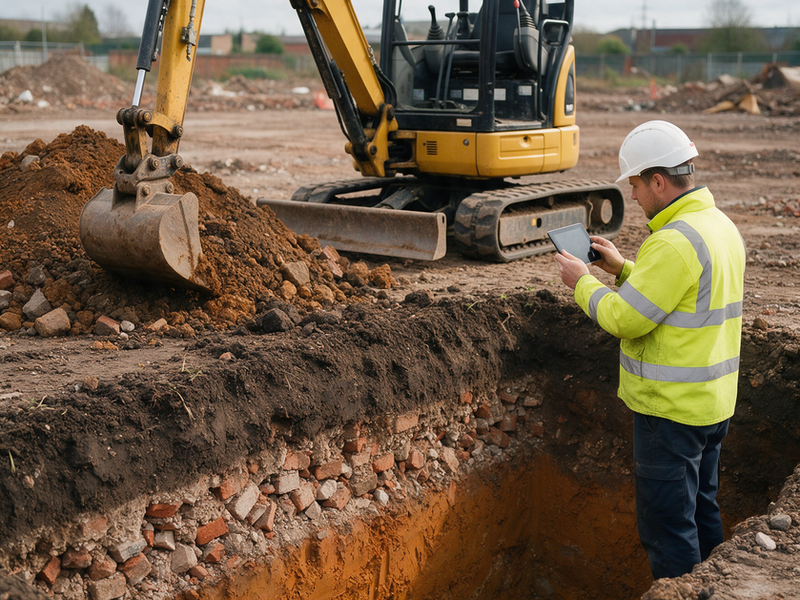
01How a BRE 365 test works.
BRE Digest 365, Soakaway design, is the standard UK method for testing ground for soakaways and infiltration drainage.
- A trial pit is dug at the proposed soakaway location and depth, typically 0.3 to 1m wide and 1 to 3m long, with vertical sides.
- The pit is filled quickly with water, often from a bowser.
- The time for the water to fall from 75% to 25% of its effective depth is recorded.
- This is repeated three times, on the same or consecutive days, and the slowest rate is used for design.
Soakaway test pits are never entered. All readings are taken from the surface.
02What the result means.
The result is an infiltration rate in metres per second, which your engineer uses to size the soakaway. As a guide, rates around 10-4 to 10-5 m/s support a reasonably sized soakaway, while very slow rates may mean infiltration is not suitable and another drainage route is needed.
Soakaways should normally be at least 5m from buildings, with the water table at least 1m below the base.
03Planning around the weather.
Wet winter ground and high groundwater can significantly reduce infiltration, so the design should allow for the worst case. We can talk you through the best time to test for your site.
Need drainage for a septic tank or treatment plant instead? That is a different test: see percolation testing, and our guide to which test you need.
04Questions we get asked.
Is a soakaway test the same as a percolation test?
No. BRE 365 is for rainwater soakaways. A Part H and BS 6297 percolation test is for septic tank and treatment plant drainage fields, and one cannot be used in place of the other.
How long does a soakaway test take?
BRE 365 needs three fill-and-drain cycles on the same or consecutive days, so it is usually a day or two on site, depending on how quickly the ground drains.
What if my ground does not drain?
The drainage hierarchy moves on to other options, such as a watercourse or sewer connection. Your engineer or building control will advise on the route.
Do I need a soakaway test for my extension?
If surface water from the extension is going to a soakaway, building control will usually want evidence the ground is suitable. We can test the ground at the proposed location.