
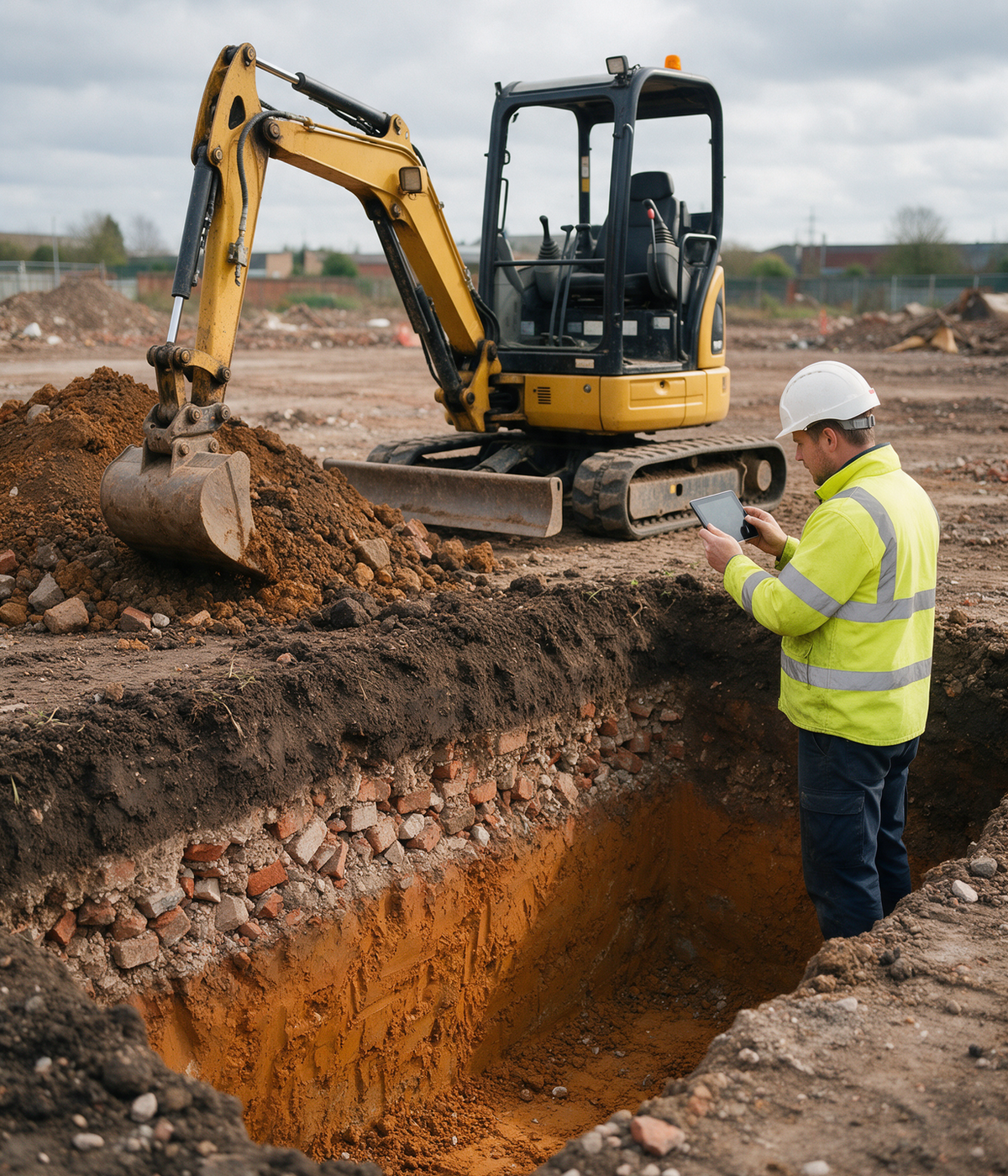
Trial pits: look and see.
- Dug by machine or by hand, usually to about 1 to 4.5m.
- Show the strata clearly, and give large bulk samples.
- Quick and good value.
- Need space for an excavator, and can disturb a garden more than a small borehole.
Both let you see what is under your site. A trial pit opens the ground up so you can look at it; a borehole goes deeper through a small hole. Which you need depends on how deep the questions go.
For shallow foundations on straightforward ground, trial pits may be all you need. Where foundations or piles need information deeper down, where access is tight, or where there may be old workings, boreholes come in. Many sites use both: pits for the detail near the surface, boreholes for depth.
A trial pit is an open excavation, usually up to about 4.5m, that lets you see the strata and take large samples. A borehole is a small-diameter hole that can go much deeper.
Trial pits are usually quicker and better value for shallow investigations. For deeper information, boreholes are the only option.
Keep reading
 Guide / Drainage
How the test works, what the Vp result means and what counts as a good result for a septic tank.
Read the guide Guide / Homeowners
Why building control may ask about your ground, and the quickest way to answer them.
Read the guide Guide / Coal mining
What it means to build in a Development High Risk Area, and when drilling for old workings is needed.
Read the guideReady when you are
Tell us about your site. We'll come back with the right approach and a price.