
Ground investigation services.
Eleven ways we help you understand the ground under your project. Most sites need a combination, and we'll recommend the right mix for yours, so you get precise results without paying for more than you need.

 01 / Investigation
Site investigation
The full picture of your ground: planned, drilled, tested and reported, for planning, design and building control.
Site investigation 02 / Drilling
Cable percussion drilling
The UK's most common borehole method, with samples and in-situ tests as we go. Boreholes up to 60m where ground and access allow.
Cable percussion 03 / Drilling
Rotary drilling and coring
Drilling into bedrock to check rock quality and look for shallow mine workings, with core recovered for logging.
Rotary drilling 04 / Drilling
Window sampling
Fast, shallow sampling from a compact rig, or a hand-held system where access is too tight for any rig.
Window sampling 05 / In-situ testing
Dynamic probing
A steel cone driven into the ground, counting the blows for every 100mm, to show how strength changes with depth.
Dynamic probing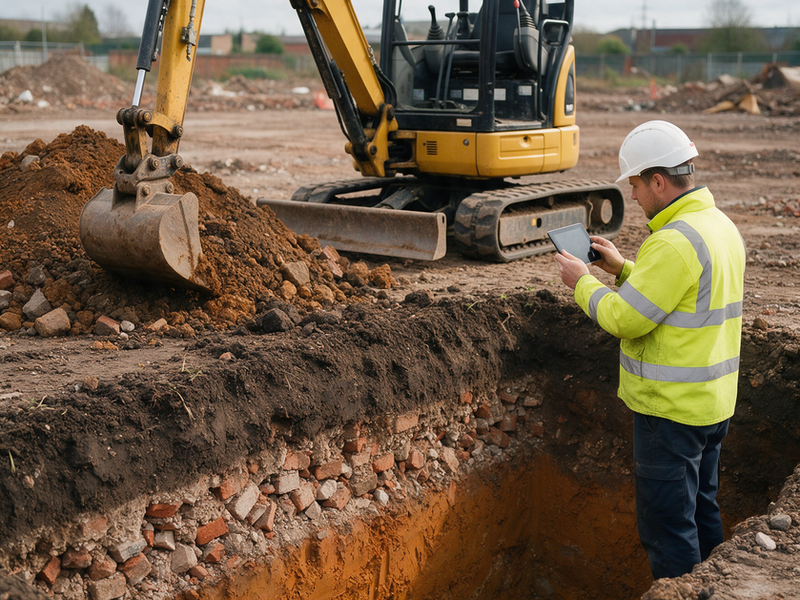 06 / Excavation
Trial pits
A proper look at the strata and large bulk samples, quicker to carry out than drilling or sampling.
Trial pits 07 / Drainage
Percolation testing
Is the ground suitable for a septic tank or treatment plant drainage field? The test that answers it.
Percolation testing 08 / Drainage
Soakaway testing
Infiltration testing to the BRE 365 method, so surface water can be designed to soak away and planning conditions can be met.
Soakaway testing 09 / Testing
Laboratory testing
Classification, strength and chemical tests on the samples we recover, so design numbers come from your ground.
Laboratory testing 10 / Environmental
Contaminated land
Sampling and testing on brownfield and previously developed land, to support planning and protect people and water.
Contaminated land 11 / Specialist
Coal mining investigation
Drilling to look for shallow coal workings and mine entries, an everyday question across Wigan and the coalfield.
Coal mining investigationWhich do I need?
A starting point, by project.
Every site is different and your engineer, architect or building control officer may ask for something specific. This is where most projects start.
| House extension | A trial pit or window sample to check the ground at foundation depth, plus a soakaway test if surface water is going to a soakaway. |
|---|---|
| Septic tank or treatment plant | A percolation test for the drainage field. |
| New homes or a small development | A site investigation: boreholes or window samples, trial pits, probing and laboratory testing, plus soakaway tests and a contamination check. |
| Former industrial or brownfield land | Contaminated land sampling and testing alongside the geotechnical work. |
| Sites in the Wigan coalfield | Rotary drilling to look for shallow coal workings, where the risk calls for it. |
| Commercial, highways and larger schemes | Cable percussion boreholes, rotary coring, in-situ testing and a full laboratory programme. |
FAQs
Before you book.
Do you take on small jobs?
Yes. We tackle any size of job, from a single soakaway test or trial pit for a house extension to a full investigation for a commercial development.
How deep can you drill?
With cable percussion drilling, boreholes up to 60m deep can be formed, depending on access and ground conditions. Where we need to go into bedrock, for example to check for shallow mine workings, we use rotary drilling.
Can you work on a tight site?
Yes. Where access is too restricted even for our compact rig, we use a hand-held window sampling system that recovers samples in the same tubes as the rig.
What do you need from me to quote?
The site address, what you're planning to build, any drawings or a site plan, and a note on access. If you have a letter from building control, a planning condition or a brief from your engineer, send that too.