01What a site investigation covers.
Every building puts load into the ground, and every site is different. A site investigation, also called a ground investigation or geotechnical survey, finds out what the ground is made of, how strong it is, where the water is and whether anything in it could cause a problem, from soft clay and made ground to old coal workings or contamination.
In the UK, ground investigations are planned and carried out to BS 5930:2015+A1:2020, the code of practice for ground investigations, and BS EN 1997-2 (Eurocode 7), which covers investigation and testing for geotechnical design. Contamination and ground gas follow their own standards, which we cover on our contaminated land page.
02From desk study to report.
Investigations usually run in stages, and the scope often changes as information comes in.
- Desk study and walkover, often called Phase 1. Maps, geology, historical records, mining data and a look at the site, to understand what might be there.
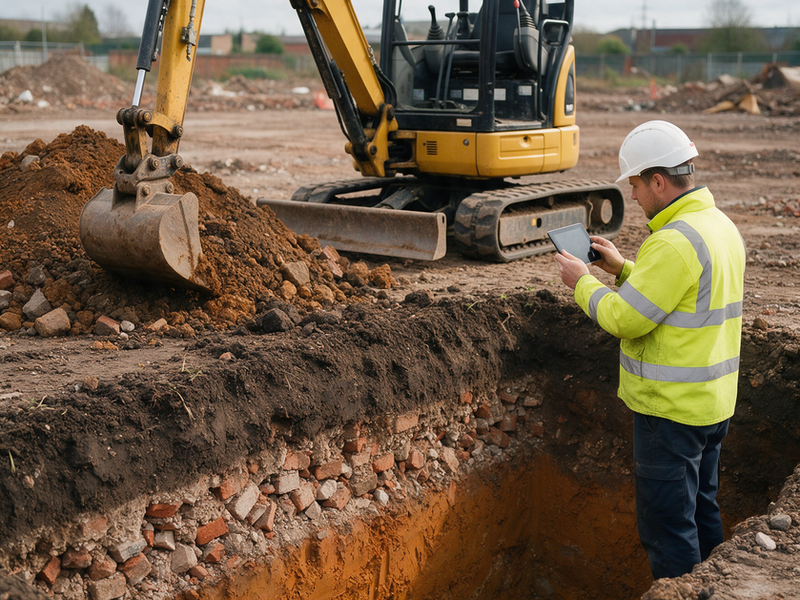
- Intrusive investigation, often called Phase 2. Boreholes, window samples, trial pits and probing on site, with samples taken and tests carried out as we go.
- Laboratory testing of the soil and rock samples, to give the numbers the design needs.
- Reporting. A factual report sets out the logs and test results. An interpretive report adds the engineering assessment and recommendations, such as foundation type.
03The right method for the ground.
We match the method to the site, the access and what your engineer needs to know:
04Big or small, the same care.
We tackle any size of job, from a single trial pit for a house extension to a full investigation for a retail park, with the same care over quality and value for money.
- Homeowners and self-builders, where building control or a warranty provider wants to know the ground can carry the foundations.
- Architects and structural engineers, who need reliable data to design foundations, retaining walls and drainage.
- Developers and contractors, where planning conditions, warranty providers and lenders all want evidence about the ground.
Warranty providers set their own minimums. NHBC, for example, requires every site to have an initial assessment, with a more detailed investigation where hazards are suspected.
05Questions we get asked.
Do I need a site investigation for a house extension?
Often, yes. Building control or your structural engineer may ask for a trial pit or borehole to confirm the soil and its depth before signing off the foundation design, especially on clay, near trees, or on filled or mined ground. It is decided case by case.
What is the difference between Phase 1 and Phase 2?
Phase 1 is a desk study and site walkover using maps, records and history. Phase 2 is the intrusive work on site: trial pits, boreholes, sampling and testing.
How much does a site investigation cost?
It depends on the size of the site, the number and depth of exploratory holes, access and the testing needed. Send us the address and what you are building and we will give you a clear quote. Our guide on ground investigation costs explains what drives the price.
What is the difference between a factual and an interpretive report?
A factual report contains the logs, field test results and laboratory data. An interpretive report adds the engineering assessment and recommendations, such as foundation type and depth.